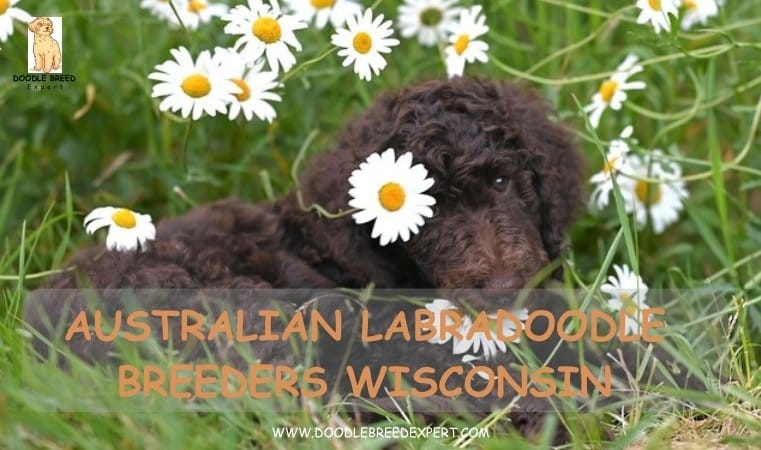
Wisconsin has three ALAA-registered Australian Labradoodle breeders, two clustered in the state’s northwest and one out on its own near Milwaukee. It’s a much smaller roster than neighboring Illinois or Minnesota, but this guide covers what’s confirmed about each program’s location and health-testing record, plus the state law and regional health risk Wisconsin buyers should know before reserving a puppy.
Two of Wisconsin’s Three ALAA Breeders Cluster in the State’s Northwest
Osseo and Bloomer sit about forty miles apart in west-central and northwestern Wisconsin, not far from Eau Claire, putting both of the state’s northern ALAA programs within a short drive of each other and of the surrounding Chippewa Valley communities.
Blueberry Cottage Labradoodles
Heather Clark runs Blueberry Cottage Labradoodles out of Osseo, Wisconsin, and holds an ALAA Golden Paw.
Location: Osseo, Wisconsin
Website: Blueberry Cottage Labradoodles
Registry: ALAA (Golden Paw)
Doodles In Bloom
Tiffany Gullickson operates Doodles In Bloom from Bloomer, a short drive from Blueberry Cottage. The program doesn’t currently hold a Paw distinction, which is typical for a newer ALAA member.
Location: Bloomer, Wisconsin
Website: Doodles In Bloom
Registry: ALAA (no Paw distinction on record)
Lake Breeze Labradoodles Rounds Out Wisconsin From the Southeast
Wisconsin’s third ALAA program sits nearly three hours away by car from the northwestern pair, in the Lake Country area west of Milwaukee.
Lake Breeze Labradoodles
Jennifer Koplin runs Lake Breeze Labradoodles out of Oconomowoc and holds an ALAA Silver Paw.
Location: Oconomowoc, Wisconsin
Website: Lake Breeze Labradoodles
Registry: ALAA (Silver Paw)
Two of Wisconsin’s Three ALAA Breeders Hold a Paw Distinction
Blueberry Cottage Labradoodles holds ALAA’s mid-tier Golden Paw, and Lake Breeze Labradoodles holds the entry-level Silver Paw. Doodles In Bloom doesn’t currently show a Paw distinction on ALAA’s records, which typically reflects newer membership rather than any red flag, and is worth a quick check directly with the breeder before reserving a puppy.
Wisconsin Winters Put the Labradoodle’s Wool Coat to a Real Test
Australian Labradoodles are usually bred with a wool or fleece coat rather than the shorter hair of a Labrador, mainly to keep shedding and dander down for allergy-sensitive families. That same coat also happens to hold up well in a Wisconsin winter, growing a thicker undercoat as temperatures drop, though it still needs regular brushing to keep it from matting once the snow and road salt start tracking in.
Oconomowoc sits in Wisconsin’s Lake Country, a cluster of glacial lakes and the nearby Kettle Moraine State Forest west of Milwaukee, while Osseo and Bloomer are closer to the rolling farm country around Eau Claire. Both regions see snow cover for a good chunk of the year, so families picking up a puppy from any of Wisconsin’s three ALAA breeders should plan on paw-pad care and coat maintenance as a normal part of winter ownership, not an exception.
Wisconsin Requires a License Once a Breeder Sells Twenty-Five Dogs a Year
Wisconsin’s Department of Agriculture, Trade and Consumer Protection licenses any breeder who sells twenty-five or more dogs a year from more than three litters they’ve bred themselves, under state administrative code ATCP 16 and the underlying statute, Chapter 173. The same licensing program covers breeding facilities, in-state dealers, out-of-state importers, and animal shelters or rescues that hit similar volume thresholds.
Licensed operators go through DATCP inspections and have to keep veterinary health certificates on file, and the law bars selling any puppy younger than seven weeks old. Licenses run on an annual cycle and expire every September 30th, and the same statute also sets standards for shelters and rescues moving comparable numbers of dogs, not just for-profit breeders. All three of Wisconsin’s ALAA-registered breeders operate at a small enough scale that this licensing threshold isn’t a practical concern, but it’s a useful backstop for buyers to know about if they ever encounter a larger-volume seller advertising online.
Wisconsin Just Had Its Worst Lyme Disease Year on Record
Wisconsin’s Department of Health Services recorded 8,929 human Lyme disease cases in 2025, the highest total on record and well above the roughly 5,300-case yearly average from 2020 through 2024. State health officials point to an early, active tick season, and the disease-carrying black-legged tick has spread from its original stronghold in the state’s northwest to nearly every county over the past thirty-five years.
That northwestern origin point matters for two of the three breeders in this article: Blueberry Cottage Labradoodles in Osseo and Doodles In Bloom in Bloomer both sit in the same region where Wisconsin’s tick population has been established longest and where case rates tend to run highest. Peak tick activity in Wisconsin falls in June and July, so puppy buyers anywhere in the state, and especially in the northwest, should talk to their vet about a monthly tick preventive and routine tick checks after outdoor time.
The Breed’s Roots Trace to a Guide Dog Need in 1980s Hawaii
The Australian Labradoodle’s story begins not in Wisconsin or even Australia, but in Hawaii, where a woman needed a guide dog but couldn’t have one because her husband’s severe allergies ruled out every breed her local guide dog school could normally place.
Wally Conron, working for the Royal Guide Dogs Association of Victoria in Australia, crossed a Labrador Retriever with a Standard Poodle in the late 1980s to try to solve that exact problem. The resulting puppies had the right guide-dog temperament, but their coats still shed more than hoped, so later breeders folded in Cocker Spaniel, Irish Water Spaniel, and Soft Coated Wheaten Terrier to fix that. Australian kennels Tegan Park and Rutland Manor spent the early 1990s stabilizing that combination into today’s Australian Labradoodle, and those same foundation bloodlines still show up in the pedigrees of every breeder featured in this article.
Frequently Asked Questions
Three programs currently hold active ALAA membership in Wisconsin: two in the northwest, near Osseo and Bloomer, and one in the southeast, near Milwaukee.
Blueberry Cottage Labradoodles in Osseo currently holds the highest tier among Wisconsin’s three ALAA programs, an ALAA Golden Paw.
Yes, Wisconsin’s Department of Agriculture, Trade and Consumer Protection requires a license for any breeder selling twenty-five or more dogs a year from more than three litters, under ATCP 16 and Chapter 173.
Wisconsin recorded its highest-ever total of human Lyme disease cases in 2025, and the black-legged tick that spreads it is now established statewide, with the northwestern region, home to two of Wisconsin’s three ALAA breeders, among the areas where the tick has been present longest.
Confirm the breeder’s current ALAA membership and Paw status directly through ALAA’s own website, ask about health testing and guarantee terms in writing, and get a sense of whether the breeder’s scale would put them under Wisconsin’s DATCP licensing requirement.
Not evenly. Two of the three are clustered in the northwest near Osseo and Bloomer, while the third is nearly three hours away in the Lake Country area west of Milwaukee, so families in central or southern Wisconsin have a longer drive than those in the northwest.
Generally yes. The wool or fleece coat that keeps shedding low also grows a thicker undercoat in cold weather, though it still needs regular brushing through the winter to prevent matting from snow and road salt.
Conclusion
Wisconsin’s three ALAA-registered breeders are a small but geographically spread group, with two clustered in the northwest and one on its own near Milwaukee, and two of the three currently holding some level of ALAA Paw distinction.
Wisconsin’s DATCP licensing threshold at twenty-five dogs a year gives buyers a regulatory backstop against large-scale sellers, though every ALAA program in this article operates well under that scale. The state’s record 2025 Lyme disease numbers are worth a serious conversation with a vet, especially for anyone near Osseo or Bloomer in the tick-established northwest, and the breed’s wool coat, while well suited to Wisconsin’s snowy winters, means budgeting for regular grooming year-round. With one pair of programs near Eau Claire’s corner of the state and another near Milwaukee, most Wisconsin families will still have a real, ALAA-registered option within a few hours’ drive, even if the state’s overall roster is smaller than its neighbors.
Australian Labradoodle Breeders In Other Places
| Alberta | British Columbia | Nova Scotia | Ontario | Ottawa |
| Australia | New South Wales | Queensland | Sydney | Victoria |