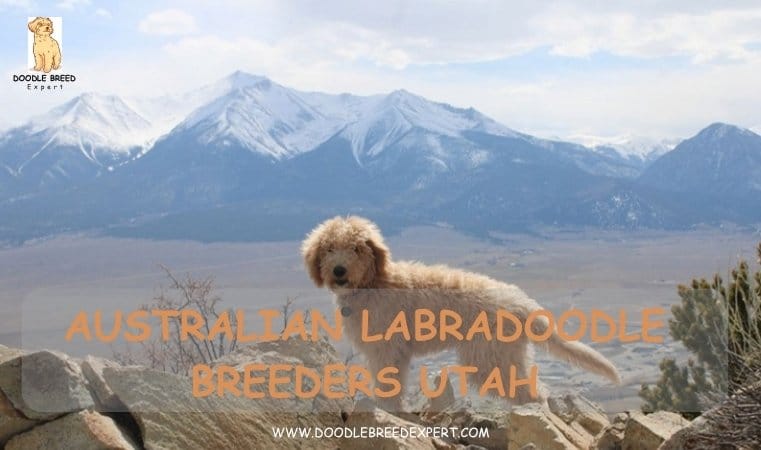
Utah has just two ALAA-registered Australian Labradoodle breeders, one in the Wasatch Front near Provo and the other in the red-rock desert near St. George.
This guide covers what’s confirmed about each program’s health-testing record, plus the state law and regional health risk Utah buyers should know before reserving a puppy.
Utah’s Two ALAA-Registered Breeders
One program is based in Utah Valley, part of the fast-growing Wasatch Front corridor south of Salt Lake City, at roughly 4,500 feet of elevation with a four-season mountain climate.
The other sits in Washington County, in Utah’s low desert corner bordering Arizona and Nevada, where summers run hot and dry and the landscape looks more like Las Vegas than Salt Lake City.
That geographic split matters for buyers: a puppy raised near Provo will be acclimated to cold winters and snow.
One raised near Hurricane grows up in a low desert climate instead, which is worth asking a breeder about if you’re relocating a puppy across the state or out of it.
EllsWORTH Labradoodles
JoAn Ellsworth runs EllsWORTH Labradoodles out of Provo, in Utah Valley, and holds an ALAA Golden Paw, one tier below the association’s Platinum designation. Her ALAA member number dates back to 2009, making it one of the longer-standing programs in this series.
Location: Provo, Utah
Website: EllsWORTH Labradoodles
Registry: ALAA (Golden Paw)
Red Desert Doodles
Max and Cindy Barker run Red Desert Doodles out of Hurricane, in Washington County near St. George. The program doesn’t currently hold an ALAA Paw distinction, which is typical for a newer member rather than any kind of red flag.
Location: Hurricane, Utah
Website: Red Desert Doodles
Registry: ALAA
Utah’s Golden Paw Breeder
Every ALAA member already clears a real bar before it ever shows up in the directory: submitted pedigrees and minimum health testing, written purchase agreements and health warranties, registered litters, and adherence to the association’s code of ethics.
Of Utah’s two ALAA members, EllsWORTH Labradoodles holds a Golden Paw, the association’s second-highest health-testing tier. Red Desert Doodles doesn’t currently carry a Paw distinction.
Because ALAA refreshes this status roughly every 24 hours, buyers should confirm a kennel’s current standing directly through ALAA’s own website rather than a badge image on a breeder’s page.
Utah’s Breeder Care Standards
Utah doesn’t require breeders to hold a state breeding license the way Texas or Tennessee do.
Instead, House Bill 478, which took effect May 1, 2024, set statewide animal care standards for anyone who breeds dogs for profit, administered by the Utah Department of Agriculture and Food. The law exempts anyone who produces no more than one litter a year.
Covered breeders can’t let a female dog produce more than one litter in any twelve-month period unless a veterinarian confirms more frequent breeding is safe.
Pregnant dogs must also get at least one prenatal or postpartum veterinary visit, and no puppy can be sold before eight weeks of age or before it’s properly weaned.
Violating these standards is an infraction carrying a $750 fine, and the Department of Agriculture and Food can add civil fines of up to $1,000 per violation, seek an injunction, or arrange for an animal’s seizure.
Some Utah cities layer their own rules on top of the state law.
Salt Lake City, for instance, issues a free five-year “Responsible Breeder” license to anyone who belongs in good standing to an accredited club like the AKC or UKC and follows that club’s written code of ethics.
That code includes a ban on selling puppies younger than eight weeks and a requirement to take back or rehome any dog the breeder produced.
Utah buyers working with a breeder in a specific city should ask whether local rules like this apply.
A separate federal layer can also apply.
Under the Animal Welfare Act, a breeder who keeps more than four intact breeding females and sells puppies sight unseen, meaning the buyer never meets the puppy or the breeder in person before the sale, is covered by federal rules.
That breeder generally needs a USDA license and inspection regardless of what state or city they’re in.
Neither Utah breeder in this article appears to operate at a scale where that federal threshold would apply, but it’s a reasonable question to ask any larger operation.
Valley Fever Risk Near St. George
Dogs catch valley fever, formally called coccidioidomycosis, by inhaling spores of the Coccidioides fungus that lives in dry, sandy desert soil across the southwestern United States.
Because dogs regularly sniff and dig at the ground, they’re exposed to these spores more than the people walking them.
Washington County, home to Red Desert Doodles in Hurricane, has Utah’s highest documented incidence of valley fever.
University of Utah researcher Katharine Walter’s team found the fungus in roughly 8 percent of soil samples collected across about 40 sites countywide, and rapid residential and golf-course development in the fast-growing St.
George area has been stirring up contaminated dust as builders excavate new lots.
Signs of infection in dogs typically appear seven to twenty-one days after exposure and include coughing, fever, lethargy, weight loss, and lameness; severe cases can progress to seizures or abscesses.
About 70 percent of exposed dogs never show symptoms and develop natural immunity on their own.
For dogs that do get sick, valley fever is treatable with antifungal medication such as itraconazole or fluconazole but isn’t curable outright, and some dogs need a year or more of treatment, with regular bloodwork to watch for liver side effects.
Puppy buyers near St. George should ask their vet about valley fever awareness at routine visits, especially for a dog that will spend time digging outdoors.
Limiting a dog’s exposure to freshly disturbed soil near construction sites, and avoiding walks on windy days when dust is airborne, are the main practical precautions vets recommend in affected areas.
How the Australian Labradoodle Began
The Australian Labradoodle’s story begins not in Australia but in Hawaii, where a woman needed a guide dog but couldn’t have one because her husband’s allergies ruled out every breed her local guide dog school could normally place.
Wally Conron, working for the Royal Guide Dogs Association of Victoria in Australia, crossed a Labrador Retriever with a Standard Poodle in the late 1980s to try to solve that exact problem.
The resulting puppies had the right temperament for guide work, but their coats still shed more than hoped, so later breeders folded in Cocker Spaniel, Irish Water Spaniel, and Soft Coated Wheaten Terrier to fix that.
Australian kennels Tegan Park and Rutland Manor spent the early 1990s stabilizing that combination into today’s Australian Labradoodle, and those same foundation bloodlines still turn up in the pedigrees of both breeders featured in this article.
Frequently Asked Questions
Two programs currently hold active ALAA membership in Utah: EllsWORTH Labradoodles near Provo in Utah Valley, and Red Desert Doodles near St. George in Washington County.
EllsWORTH Labradoodles holds an ALAA Golden Paw, the state’s highest current distinction. Neither Utah breeder currently holds ALAA’s top Platinum Paw.
Not a statewide breeding license. House Bill 478, effective May 1, 2024, sets care standards instead, including a one-litter-per-year limit per female and a minimum puppy sale age of eight weeks, enforced by the Utah Department of Agriculture and Food. Some cities add their own breeder licensing on top of that.
Valley fever is a fungal infection dogs catch by inhaling Coccidioides spores from desert soil. Washington County, near St. George, has Utah’s highest documented incidence, so dogs living or visiting there face a real regional exposure risk.
Confirm the breeder’s current ALAA membership and Paw status directly through ALAA’s own website, ask whether any city-level breeder license applies where they operate, and get any health guarantee in writing before paying a deposit.
Policies vary by breeder, so this is worth asking directly. Many ALAA member breeders across the country will ship or personally deliver puppies well beyond their home state, so a small statewide roster doesn’t necessarily limit a Utah family’s options.
Conclusion
Utah’s ALAA roster is one of the smallest covered in this series, with just two verified programs anchoring opposite corners of the state: one a longer-standing Golden Paw kennel in Utah Valley, the other a newer desert program near St.
George without a Paw distinction yet.
Utah buyers get lighter statewide oversight than states with a breeder-licensing law, relying instead on care standards under House Bill 478 and whatever license their specific city may require.
Anyone considering the St. George area should also factor in valley fever as a genuine regional health risk worth discussing with a vet.
Australian Labradoodle Breeders In Other Places
| Alberta | British Columbia | Nova Scotia | Ontario | Ottawa |
| Australia | New South Wales | Queensland | Sydney | Victoria |