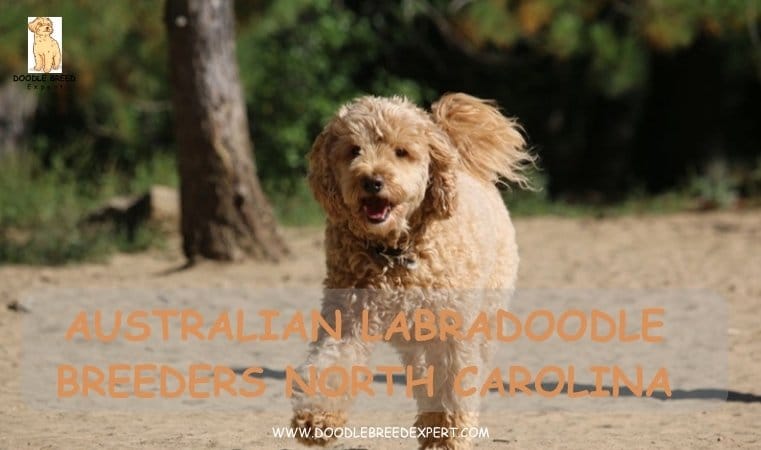
There are at least eight active, currently operating Australian Labradoodle breeders located in North Carolina, and several of them have earned high health-testing ratings from ALAA and WALA. North Carolina also has no puppy lemon law, and some of its mountain counties now report some of the fastest-growing tick-borne disease rates in the state.
North Carolina Breeder Pricing: Mostly Private, With Two Exceptions
Most of North Carolina’s Labradoodle breeders don’t display prices on their websites, preferring to talk about cost directly with potential customers. Two of the breeders featured here are exceptions to that rule: BelleauWood Australian Labradoodles displays a pet price of $3,000 with a non-refundable deposit of $500 that transfers to future litters, and Springdale Labradoodles displays a puppy price of $3,500 with a non-refundable $500 reservation fee applied toward the purchase price.
North Carolina Has No Puppy Lemon Law For Pet Buyers
North Carolina is also unique among its neighbors in that it has never established a puppy lemon law. A review of pet-purchase consumer protection laws nationwide, conducted through an industry policy analysis, found that roughly two dozen states have laws providing consumers with protections when purchasing pets, split roughly evenly between laws that protect against pet dealers only and laws that protect against both breeders and dealers. North Carolina doesn’t fall into either category. For comparison, South Carolina, just across the border, does have a puppy lemon law offering protections similar to those other states.
Although North Carolina regulates animal welfare in general, it hasn’t provided a way to obtain a refund or exchange for a dog that becomes ill after purchase. Instead, the state has enacted Chapter 19A, Article 3 of the NC General Statutes, commonly known as the Animal Welfare Act, which regulates shelters, kennels, pet stores, dealers, and public auction houses. It doesn’t, however, establish regulations for private transactions. So a buyer who purchases an Australian Labradoodle from a home breeder and later finds the puppy sick would have no recourse under state law for reimbursement or replacement.
Under Section 19A-23 of the NC General Statutes, an individual is exempt from dealer licensure where that person breeds and raises no more than the offspring of five female canines or felines per year on their own premises. Since each of the home-based Australian Labradoodle programs featured here has fewer than five breeding females, none of them are licensed as dealers under state law. Operating an unlicensed kennel or pet store is classified as a Class 3 misdemeanor, punishable by fines of $5 to $25 per day, a penalty many in the industry consider largely symbolic.
Meet North Carolina’s Most Decorated Australian Labradoodle Breeders
DownUnder Labradoodles USA
DownUnder Labradoodles USA, based in Raleigh, is arguably the most credentialed Australian Labradoodle program in the state: its owner is a founding and current ALAA board member, a past ALCA board member, and an ALAA Gold Paw certified breeder. The program has been breeding since 2002, longer than any other North Carolina breeder identified for this article, and offers miniature, medium, and standard sizes with a two-year health guarantee.
Location: Raleigh, North Carolina
Website: DownUnder Labradoodles USA
Registry: ALAA (Gold Paw, founding board member), ALCA (past board member)
Springdale Labradoodles
Springdale Labradoodles has received a Platinum Paw award from the Australian Labradoodle Association of America (ALAA) and an All-Star award from the Worldwide Australian Labradoodle Association (WALA), putting it among the few programs with that level of recognition in the Labradoodle community here. Springdale currently produces both medium and mini-sized Australian Labradoodles weighing between 15 and 45 pounds, with parents that are OFA and CHIC certified. The price of each puppy is $3,500 plus a $500 non-refundable reserve deposit, which is applied toward the cost of the puppy.
Location: Greensboro, North Carolina
Phone Number: 336-736-9680
Website: Springdale Labradoodles
Registry: ALAA (Platinum Paw), WALA (All-Star)
Good Day Doodles
Good Day Doodles is an ALAA Golden Paw breeder that’s also WALA-accredited, and the program states it has been breeding Australian Labradoodles for more than 15 years with a focus on multigenerational lines. Puppies are raised in-home, and the breeder also operates a guardian-home program for some of its adult dogs.
Location: Milton, North Carolina
Phone Number: (336) 505-9606
Website: Good Day Doodles
Registry: ALAA (Golden Paw), WALA
Tillery Labradoodles
As an ALAA Silver Paw breeder, Tillery Labradoodles carries membership number ALAA-007577, obtained in 2019, though the program began producing Australian Labradoodles around 2015. It produces apricot, chalk, chocolate, and cream-coated puppies in mini and small-medium sizes, backs all its puppies with a two-year health guarantee, and describes itself as a small home-based program rather than a kennel.
Location: Mount Gilead, North Carolina
Phone Number: (910) 220-7110
Website: Tillery Labradoodles
Registry: ALAA (Silver Paw, #ALAA-007577)
Lucky Country Labradoodles
Lucky Country Labradoodles, located in Wake Forest, is a WALA Star Breeder and is listed among ALAA members rated “Excellent” through Good Dog. It has been producing standard-size Australian Labradoodles exclusively since 2010; its dogs weigh 45 to 90 pounds and stand 19 to 26 inches tall, are OFA tested, and are CHIC registered. Lucky Country participates in the Spay Secure program and keeps no more than four female dogs at a time in the home.
Location: Wake Forest, North Carolina
Website: Lucky Country Labradoodles
Registry: WALA (Star Breeder), ALAA
Three More North Carolina Programs Worth Contacting
Brown’s Labradoodles
Brown’s Labradoodles LLC is an ALAA member owned and operated by Larry Brown out of Reidsville, North Carolina. Based on its BBB listing, the program has approximately 14 years in operation. Its website wasn’t directly accessible while researching this article, so contacting the breeder directly for current information is recommended.
Location: Reidsville, North Carolina
Phone Number: (336) 543-7408
Registry: ALAA
BelleauWood Australian Labradoodles
BelleauWood Australian Labradoodles is a family-run program located just outside Greensboro, operated by a mother-daughter team. It’s a WALA member that uses Paw Print Genetics testing on its breeding dogs and is one of only two North Carolina breeders featured in this series to publicly post prices: a pet price of $3,000 with a $500 non-refundable deposit that can be transferred if the litter is delayed.
Location: Greensboro, North Carolina (with a satellite location in South Carolina)
Website: BelleauWood Australian Labradoodles
Registry: WALA
Prestige Australian Labradoodles
Prestige Australian Labradoodles operates in southern Wake County and serves the areas around Raleigh, Durham, and Chapel Hill. It’s associated with both ALAA and WALA, uses OFA testing for hips, elbows, and eyes along with EIC and prcd-PRA genetic screening, and provides a two-year health guarantee. The Prestige website also mentions an international registry referred to as ILA, but what that acronym refers to couldn’t be confirmed through independent means, so a prospective buyer should ask the breeder directly about the status of that particular credential.
Location: Southern Wake County, North Carolina
Phone Number: 919-909-4762
Website: Prestige Australian Labradoodles
Registry: ALAA, WALA (additional “ILA” claim unverified)
North Carolina’s Mountain Counties Are a Growing Tick-Borne Disease Hot Spot
The 2024 Tickborne Disease Report issued by the N.C. Department of Health and Human Services found that Lyme disease cases increased slightly during 2024, with a total of 247 cases in North Carolina, or 2.2 per 100,000 residents. This represents a small increase from 2023, when there were 233 cases. The majority of these cases were concentrated in the mountainous region of western North Carolina, particularly in Yancey, Mitchell, Madison, Alleghany, and Ashe counties, where each exceeded 30 cases per 100,000 residents; approximately 75 percent of these cases were contracted inside the state.
Ehrlichiosis cases increased dramatically in the same report, from 115 cases in 2023 (1.1 per 100,000) to 278 cases in 2024 (2.5 per 100,000), primarily in central and western North Carolina. Of the 278 ehrlichiosis cases documented, nearly 23 percent required hospitalization, and four were fatal.
Spotted fever rickettsiosis, which includes Rocky Mountain spotted fever, was relatively stable in 2024 with 195 reported cases (1.8 per 100,000), a slight decline compared to the 229 cases reported in 2023; Avery, Watauga, and Chatham counties experienced the highest rates of incidence in the state. According to the Companion Animal Parasite Council’s 2026 forecast, North Carolina, along with Ohio, Kentucky, West Virginia, and northern Tennessee, is identified as an area where the country will see significant increases in Lyme disease risk, and North Carolina is also grouped with Virginia as having some of the country’s highest ongoing ehrlichiosis and anaplasmosis risks due to the expansion of the lone star tick.
How a Guide-Dog Request in Hawaii Created an Entirely New Breed
The Australian Labradoodle didn’t come into being as part of a design trend; instead, it was created in response to one specific request. A woman in Hawaii needed a guide dog, but her husband had severe allergic reactions to all of the standard guide-dog breeds available at the time.
Wally Conron, who worked for the Royal Guide Dogs Association of Australia in the 1980s, attempted to solve that problem by crossing a Labrador Retriever with a Standard Poodle. The resulting puppies were capable of performing the tasks required of a guide dog, but like most Labradors, they still shed noticeably, so breeders spent years afterward developing a crossbreed with Cocker Spaniel, Irish Water Spaniel, and Soft Coated Wheaten Terrier to produce a coat that would shed less.
By the early 1990s, both the Tegan Park and Rutland Manor programs in Australia had stabilized the coat and temperament traits of the Australian Labradoodle. Some of North Carolina’s ALAA- and WALA-affiliated breeders, including DownUnder Labradoodles USA, trace their programs directly back to that same foundational work.
Frequently Asked Questions
No. North Carolina does not have a puppy lemon law. The Animal Welfare Act (Chapter 19A, Article 3), which regulates pet shops, kennels, and animal dealers, makes no provision for private breeder sales, so there’s no right to a refund or exchange when buying from an individual seller.
Only a breeder who raises the offspring of more than five female dogs a year on their own premises qualifies as a “dealer” under North Carolina’s law. None of the programs featured here operate at that level.
Yes. Many of the counties in western North Carolina are higher-risk for Lyme disease. According to data released by the NC Department of Health and Human Services (NCDHHS) in 2024, North Carolina had 247 reported statewide Lyme disease cases, with Yancey, Mitchell, Madison, Alleghany, and Ashe counties all exceeding 30 reported cases per 100,000 residents. Additionally, according to the Companion Animal Parasite Council’s (CAPC) 2026 forecast, North Carolina will experience one of the greatest increases in Lyme disease risk nationally.
DownUnder Labradoodles USA and Springdale Labradoodles both stand out for their credentials. DownUnder is an ALAA founding board member and Gold Paw certified breeder, while Springdale holds an ALAA Platinum Paw award plus a WALA All-Star Award. Several other breeders, including Tillery, Lucky Country, and Good Day Doodles, have each earned at least an ALAA Silver or Golden Paw distinction and are affiliated with WALA.
Ask the breeder directly about current pricing, since only two of the breeders featured here post it online. Request a written health guarantee, since there’s no North Carolina puppy lemon law providing relief on its own, making that guarantee the buyer’s best protection. Confirm that the breeder is registered with either ALAA or WALA, and given how rapidly ehrlichiosis and Lyme disease cases have grown in North Carolina’s mountain counties, ask about the tick-prevention methods the breeder uses throughout the year.
Conclusion
At least eight active Australian Labradoodle breeders serve families in North Carolina, many carrying health-testing distinctions awarded by ALAA or WALA. North Carolina has no puppy lemon law, so a written health guarantee from the breeder is the primary protection available to a buyer. Pricing information is rarely available on breeder websites, so a direct conversation is required to get a current number.
Given the rapid growth in ehrlichiosis and Lyme disease cases in North Carolina’s mountain counties specifically, asking whether a breeder uses tick-prevention methods year-round is worth taking just as seriously as confirming registration with ALAA or WALA.
Australian Labradoodle Breeders In Other Places
| Alberta | British Columbia | Nova Scotia | Ontario | Ottawa |
| Australia | New South Wales | Queensland | Sydney | Victoria |