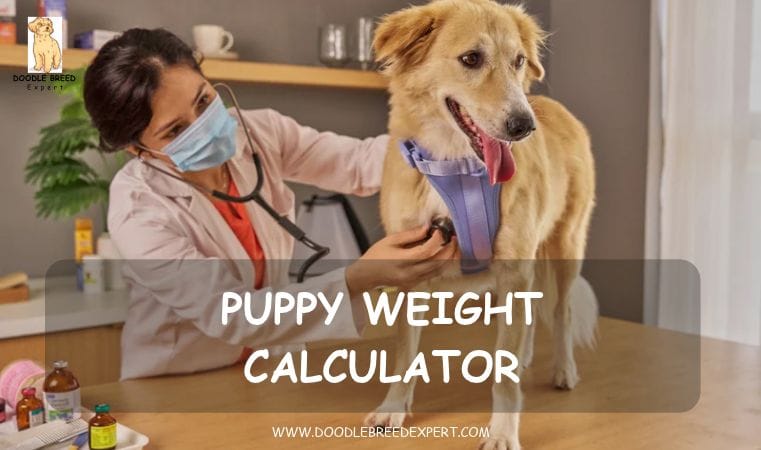
Every single dog owner will ask themselves at some point, generally when they are staring at their new puppy’s large (what appear to be) oversized paws… how big is my puppy actually going to get? The Puppy Weight Calculator provides an accurate estimate of adult size, taking into account your puppy’s age, current weight and estimated final adult size as well as providing a general idea of what their expected development will look like from the time you get them to the day they reach maturity.
It works for any breed or mix. If you have a Goldendoodle, use our Goldendoodle puppy weight calculator instead, since it has Doodle-specific size ranges for eight breeds.
Puppy Weight Calculator
Enter your puppy’s age and weight. If you don’t know their adult size category, leave it on “Not sure” and the calculator will find the best fit.
How the Puppy Weight Calculator Works
The majority of puppy weight calculators that exist today have been built using one simple formula for all dogs, such as “doubling your puppy’s weight at 16 weeks” or “multiplying your puppy’s weight by 4 at 14 weeks.” While these formulas can work fairly well with many medium-sized puppies, they completely fall apart with both small and extremely large breeds. As we know, a Yorkie does not develop in the same way as a Great Dane.
This calculator has five different growth charts, one for each adult size category. The growth charts indicate approximately what percent of adult weight a puppy will have gained at a certain time in life. A toy puppy is roughly at half adult weight by 12 weeks. On the other hand, a giant puppy of the same age would likely be only a quarter of the way to full adult weight.
Therefore, the calculation is relatively easy; it involves dividing the puppy’s current weight (in lbs) by the percentage of total adult weight that the puppy currently represents. For example if a 16-week old puppy weighs 22 pounds and is 55% grown, then we can estimate its adult weight at approximately 40 pounds.
If you select “Not sure” when prompted to enter the puppy’s expected adult size, the calculator will run the information through all five adult size charts. It will then pick the chart where the estimated adult weight actually fits that size range. Selecting this option can be helpful if you have a mixed-breed or rescue puppy whose parents’ sizes are unknown.
Puppy Weight Chart by Size
Here is a general idea of what share of their adult weight puppies carry at each age. Use this as a rough guide alongside the calculator.
| Age | Toy | Small | Medium | Large | Giant |
| 8 weeks | 33% | 30% | 27% | 22% | 18% |
| 12 weeks | 50% | 45% | 41% | 34% | 28% |
| 16 weeks | 64% | 59% | 55% | 46% | 38% |
| 6 months | 85% | 80% | 75% | 65% | 56% |
| 9 months | 97% | 94% | 90% | 84% | 76% |
| 12 months | 100% | 100% | 99% | 96% | 90% |
| Fully grown | 9-10 mo | 10-12 mo | 12-13 mo | 14-16 mo | 18-24 mo |
The numbers listed are just estimates. Puppies will vary from their breed average and this is what makes individual puppies unique.
When Do Puppies Stop Growing?
Small breeds grow and develop at a faster rate than larger breeds. Toy breeds generally reach full adult size by 9-10 months of age, and most small breeds by about a year. Medium breed puppies follow closely.
Large and Giant breed puppies are quite different. For example, a Labrador puppy may continue to add mass until 15-16 months of age, and a Great Dane or Bernese Mountain Dog can keep growing until close to two years. Height usually stops first. However, chest depth and overall muscle development can be seen continuing for a while after that.
This matters for more than curiosity. Large and giant breed puppies are prone to developmental orthopedic problems if they grow too fast, which is why they need a large-breed puppy food and careful portion control. Our puppy feeding schedule calculator helps with that part.
How Accurate Are Puppy Weight Predictions?
In all honesty, the best time to determine the mature weight of your puppy will depend on when you ask. When your puppy is at 8 weeks of age, there is still a great deal of growth to come in terms of weight, and a relatively small variance (even one pound) will result in a large swing in the eventual adult weight. By 5-6 months of age, however, the estimated adult weight becomes much more reliable.
That’s why the result comes with a range, and why that range gets narrower as your puppy gets older. If you weigh your puppy every two weeks and re-run the calculator, you’ll see the estimate settle.
Things the calculator can’t see:
- Parent size. Still the single best predictor. If you know mum and dad’s weights, the average of the two is a solid sanity check.
- Mixed genetics. A cross between a small and large breed can follow either parent, or land somewhere unexpected.
- Body condition. An overweight puppy will inflate the estimate. A puppy recovering from illness or parasites may underestimate it.
- Sex. Males usually end up a little heavier, but within a breed the difference is often smaller than people expect.
Other Ways to Guess Your Puppy’s Adult Size
Look at the paws
The growth of large paws on smaller leg bones is a common sign that there may be additional growth yet to happen in the puppy. However, it is also possible that a puppy could have larger than average paw pads due to the genetics of their specific breed.
Ask the breeder
A responsible and experienced breeder will have a general understanding of how much their puppies grow based on what they know of the parents (and grandparents) of the puppy. They should be able to provide you with estimated adult weights of both parent dogs, rather than simply telling you whether or not each was considered “small”, “medium” or “large”.
Try a DNA test
For those who purchase a dog that does not have purebred lineage, a DNA testing kit can help identify the ancestry of the dog. In addition to helping narrow down the potential breeds in your puppy’s genetic makeup, many DNA kits can also provide an estimate of your puppy’s predicted adult weight.
Watch the growth plates
Your veterinarian will be able to identify whether an X-ray shows an open (growing) plate by viewing the X-ray. The growth plates are closed once they have finished growing. It would be unnecessary to get an X-ray specifically to determine this about your puppy; however, if your puppy needs radiography for some other health issue it is certainly worth inquiring as to whether there is any opportunity to review these images to see whether your puppy’s plates have closed.
Is My Puppy Growing Normally?
Hitting a specific number matters less; what does matter is that their rate of growth remains consistent. Every week or so weigh your puppy using the same scale, at approximately the same time of day. Document each weight measurement.
Talk to your vet if you notice any of the following:
- Weight stays flat for more than two weeks in a young puppy
- Weight drops
- You can see ribs, hips or spine clearly
- You can’t feel the ribs at all under a layer of fat
- Diarrhea, vomiting, a pot belly or poor appetite alongside slow growth
Intestinal worms are one of the most common reasons a puppy grows slowly, so keep up with a proper puppy wormer schedule.
Frequently Asked Questions
Divide your puppy’s current weight by the share of adult weight they’ve reached for their size and age. Our calculator does this for you and gives a likely range.
Only roughly, and mostly for small to medium dogs. Toy puppies are past half by then, while large and giant breeds are often well under half.
A common rule for small and medium dogs is to double the 12-week weight and add a little. Large and giant breeds can end up three or four times their 12-week weight, so use a size-specific calculator.
Toy and small dogs finish at about 9-12 months, medium dogs around 12-13 months, large dogs at 14-16 months and giant breeds closer to 18-24 months.
Big paws can hint at more growth, but they aren’t reliable. Parent size and current growth rate are far better predictors.
Yes. Choose “Not sure” for adult size and the calculator picks the growth curve that best matches your puppy’s numbers.
Puppies grow in spurts, and early estimates carry more uncertainty. The estimate usually settles down by 5-6 months.
Early neutering can delay growth plate closure slightly, which may make some dogs a little taller. It doesn’t change adult weight much on its own, but calorie needs drop afterwards, so watch portions.
See your vet, especially if there’s diarrhea, vomiting or low appetite. Worms and diet problems are common causes and are usually easy to fix.
Vet note: This puppy weight calculator was written and reviewed by Dr. Muhammad Usman, DVM. It gives an estimate for general information and does not replace a check-up with your own veterinarian.
More tools: Dog Years Calculator · Dog Crate Size Calculator · Puppy Vaccination Chart