
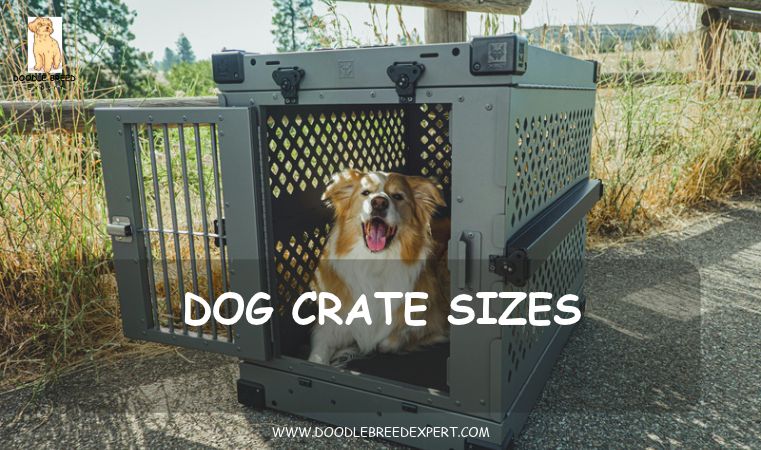
One of those first time dog buyer mistakes that most people make is getting the wrong crate. Too small and they’ll have no room to stretch. Too big and a little pup will be happy to pee in one corner. Our Dog Crate Size Calculator uses only two easy measurements so we can give you the correct crate size. Below is a guide that covers all common crate sizes (18 to 54 inches).
Buying for a puppy? You can also add their expected adult size, and the calculator will suggest a crate that lasts and tell you whether you need a divider.
Dog Crate Size Calculator
Measure your dog standing up. Length runs from the tip of the nose to the base of the tail (not the tip). Height runs from the floor to the top of the head, or the ear tips if they stand up.
How to Measure Your Dog for a Crate
All you will need is a soft tape measure and a dog who will stand still for approximately 5 seconds. And, treats always help.
- Length: with your dog standing, measure from the tip of the nose to the base of the tail. Don’t include the whole tail, a wagging tail doesn’t need to fit lying flat.
- Height: measure from the floor to the top of the head while standing. If your dog has upright ears, measure to the ear tips. If they sit taller than they stand, measure them sitting.
- Add the room: add 2-4 inches to the length and about 3 inches to the height. That’s the minimum inside space your crate needs.
Something many other sizing guides miss is that crate sizes are determined by the external length of the crate. The internal usable space is often 1-2 inches smaller than the external measurement, especially if it’s a plastic crate with a curved door. Always look up the interior dimensions when reviewing the product listing.
Dog Crate Size Chart
| Crate size | Typical dimensions (L x W x H) | Dog weight | Example breeds |
| 18 inch (XS) | 18 x 12 x 14 in | Up to 10 lb | Chihuahua, Yorkie, toy Maltipoo |
| 22 inch (S) | 22 x 13 x 16 in | 11-15 lb | Shih Tzu, Pomeranian, Toy Poodle |
| 24 inch (S) | 24 x 18 x 19 in | 16-25 lb | Cavapoo, Pug, Mini Schnoodle, Boston Terrier |
| 30 inch (M) | 30 x 19 x 21 in | 26-40 lb | Beagle, Cocker Spaniel, Mini Goldendoodle, Mini Aussiedoodle |
| 36 inch (L) | 36 x 23 x 25 in | 41-70 lb | Border Collie, Medium Goldendoodle, Bulldog, Australian Shepherd |
| 42 inch (XL) | 42 x 28 x 30 in | 71-90 lb | Labrador, Golden Retriever, Standard Labradoodle |
| 48 inch (XXL) | 48 x 30 x 33 in | 91-110 lb | German Shepherd, Standard Bernedoodle, Rottweiler |
| 54 inch (Giant) | 54 x 37 x 45 in | 110 lb + | Great Dane, Mastiff, Newfoundland |
Weight is just an estimate. More important factors for choosing a crate are your pet’s height and overall body type. For example, a tall 40 pound whippet would need a very different crate from a stout 40 pound bulldog. This is why the calculator provided uses the measurements you provide, rather than weight.
Crate Sizes for Doodles
Doodle breeds are difficult to estimate based on their name alone; many doodle breeds can be either 15 pounds or 80 pounds. Therefore, use the adult size your breeder expects when using this tool.
| Doodle size | Adult weight | Crate size |
| Toy / Petite Doodle | Under 20 lb | 24 inch |
| Mini Doodle | 20-35 lb | 30 inch |
| Medium Doodle | 35-50 lb | 36 inch |
| Standard Doodle | 50-90 lb | 42 inch |
| Large Standard Bernedoodle | 90 lb + | 48 inch |
Not sure how big your Doodle will get? Run their numbers through the Goldendoodle puppy weight calculator, which covers eight Doodle breeds, before you buy.
Crate Size for a Puppy: Buy Big and Use a Divider
Puppies grow rapidly into adulthood and therefore require new cages quickly. As such, purchasing multiple crates within a few short months becomes cost prohibitive. In most cases, you will want to purchase the crate that your dog will need in its adult form and place a divider panel to limit access to additional space. Most wire crates include a single divider panel.
Why should I place a divider panel in my crate? Dogs have a natural aversion to defecating near areas in which they rest (if the area is limited enough to create a “den”). However, this aversion does not occur in large spaces. If you give a 10 week old puppy a 42 inch long cage with no divider, it creates ample space to urinate at one end of the cage and sleep at the opposite end of the cage. This greatly hinders housebreaking efforts.
Set the divider so your puppy can stand, turn around and lie flat, and not much more. Move it back every couple of weeks. Our potty training chart for puppies goes into how the crate fits into a toilet routine.
Signs Your Dog’s Crate Is the Wrong Size
Too small
- Your dog’s head or ears touch the roof when sitting
- They can’t lie on their side with legs stretched out
- They struggle to turn around
- They lie curled up tightly every single time, even on hot days
Too big
- A puppy keeps having accidents in one corner
- Your dog slides around in a travel crate during car rides
- Your dog seems unsettled and won’t settle in one spot
Types of Dog Crates and How Sizing Differs
Wire crates
Most commonly found. Folds flat and has good ventilation. Typically comes with a divider. Wire crate sizes are very similar to each other among manufacturers so the above sizing chart will match just about all wire crates.
Plastic crates
Cosier and necessary for almost all commercial air travel. There is significantly less internal space than the labeling indicates due to the rounded shape and doorway so go one size larger if you are between two sizes.
Soft-sided crates
Very light weight and portable for travel, however they are not suitable for chewers or puppies that are still learning to be housebroken. Often the manufacturer’s sizing is smaller than its corresponding wire crate of the same name.
Furniture-style crates
They look nice in a living room but often have less height inside because of the tabletop. Check interior measurements carefully, especially for tall breeds.
Crate Size for Air Travel
IATA live animal regulations are followed by most commercial airlines. The dog you plan to take into the air must be able to stand up from its lying position without having to put its head against the roof of the crate. In addition, it should be able to make a full circle and get back onto its side in a normal (natural) way. Most airlines have a mathematical formula for determining whether or not the crate is large enough to meet their minimum standards, which will result in an unacceptable crate being denied at check-in if it does not pass the test. Before you purchase your travel crate always go to your specific airline website to review their individual travel crate requirements, since many times these are tighter restrictions than what has been suggested for the pet owner at home.
Frequently Asked Questions
Measure your dog’s length from nose to base of tail and height from floor to top of head. Add 2-4 inches to the length and about 3 inches to the height, then pick the smallest crate that beats both numbers.
Not for a puppy, unless you use a divider. Too much space can slow house training. For adult dogs, a little extra room is fine, as long as they still feel secure.
Most 50 lb dogs fit a 36 inch crate. Tall or long-bodied dogs of that weight may need a 42 inch crate, so measure first.
Mini Goldendoodles usually need a 30 inch crate, Mediums a 36 inch crate and Standards a 42 inch crate.
Yes. Your dog should be able to stand without the head touching the top, turn around easily and lie down fully stretched out.
Crate sizes are usually named by the outside length. Inside space is often 1-2 inches smaller, so check the interior dimensions.
Get a crate that fits your puppy’s expected adult size and use a divider panel to make it smaller while they grow.
Your dog’s head touches the roof, they can’t stretch out on their side, or they struggle to turn around. Any of these means it’s time to size up.
Yes. A crate that’s too big lets puppies toilet in one end, and in a car it lets dogs slide around. Use a divider or a smaller travel crate.
Vet note: Written and reviewed by Dr. Muhammad Usman, DVM. A crate should be a safe resting space, never a punishment, and adult dogs shouldn’t be crated for most of the day.
More tools: Dog Harness Size Chart · Dog Collar Size Chart · Puppy Weight Calculator