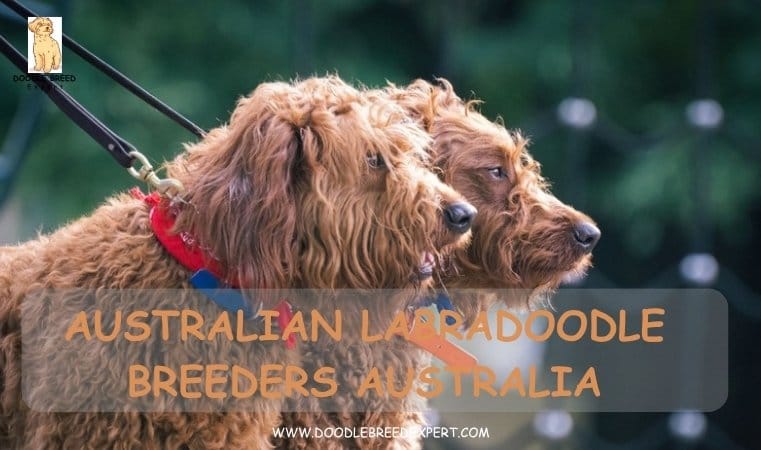
Australia has seven confirmed Australian Labradoodle breeders in WALA’s directory, spread across three states. This guide rounds up all seven in one place, with links to the full state-by-state profiles Doodle Breed Expert has published for New South Wales, Queensland, and Victoria.
Australia’s Seven WALA-Registered Breeders
New South Wales: One Breeder
Inja Labradoodles operates out of Kurrajong, in the Hawkesbury region roughly 75 kilometers northwest of Sydney, run by Taryn Wynne through a guardian-home program. The program breeds Miniature, Medium, and Standard Labradoodles and carries WALA registration number WALA-0520-01335.
Queensland: Two Breeders
Belloui Labradoodles, founded by Nicole Goggins and now continued by her daughter Belle, breeds from Brookfield on Brisbane’s western edge under WALA-0919-00910. Journey Australian Labradoodles, run by Michael Whitty from Redbank Plains southwest of the city, breeds Miniature and Medium sizes under WALA-0819-00875.
Victoria: Four Breeders
Victoria carries the largest cluster: Cypress Labradoodles in Oakleigh South (WALA-0326-12755), Gingerbred Labradoodles in Torquay (WALA-0226-12730), and Mountain Ash Labradoodles in Upwey (WALA-0526-12805).
The fourth is Silverleaves Labradoodles, run by Lyndsey and Chloe, whose current base is listed as Pakenham on the breeder’s own site against Pascoe Vale in WALA’s directory (WALA-0323-11540).
Full profiles for every one of these seven programs, including contact details, sizes, and each state’s own government registration rules, are available in Doodle Breed Expert’s dedicated New South Wales, Queensland, and Victoria guides.
Seven confirmed breeders across a country of roughly 26 million people is a genuinely small number, smaller than what most single US states covered on this site carry on their own.
That scarcity is exactly why verifying WALA membership directly, rather than trusting a breeder’s own website claim, matters more in Australia than almost anywhere else this site covers.
Why WALA, Not ALAA, Covers Australian Breeders
This is worth stating plainly once at the national level rather than state by state: the Australian Labradoodle Association of America’s own breeder directory shows zero members based in Australia, despite the breed itself originating there.
That’s not a gap in any one state’s coverage; it’s a total absence across the entire country.
WALA, the Worldwide Australian Labradoodle Association, is the real, verifiable registry that fills that space for Australian buyers.
Founded by breeders in the United States and Canada, WALA has grown into an organization with members across roughly 30 countries and seven global regions, including a dedicated Australia and New Zealand region.
It requires health testing and Code of Ethics compliance from every member.
Breeder Registration Rules Vary by State
Buyers moving between states quickly discover that Australia has no single national breeder-registration scheme; each state runs its own, under its own timelines and its own name for the identifier.
New South Wales introduced a mandatory Breeder Identification Number under the Companion Animals Act, effective December 1, 2025, with a 14-day registration window once a breeder becomes aware of an expected litter.
Queensland requires a Supply Number under the Animal Management (Cats and Dogs) Act, issued free of charge but needing registration within 28 days of a litter’s birth and annual renewal after that.
Victoria has required a Pet Exchange Register source number on every advertisement since July 1, 2020, under the Domestic Animals Act, with the registration path varying by how many breeding animals a program keeps.
The practical takeaway for any buyer is the same regardless of which of the three states a breeder is in: a missing state-issued number on an advertisement is a red flag, and it sits alongside, not instead of, verifiable WALA membership.
Where the Australian Labradoodle Breed Began
Every Australian Labradoodle bred anywhere in the world today traces back to a single dog bred in Victoria in the late 1980s.
Wally Conron worked at the Royal Guide Dogs Association of Victoria when a blind woman in Hawaii needed a guide dog that wouldn’t trigger her husband’s severe allergies, and his solution was crossing a Labrador Retriever with a Standard Poodle and naming the puppy Sultan.
Sultan worked successfully as a guide dog for a decade, and Conron coined the catchy crossbreed name specifically to help the concept overcome the stigma that typically surrounded mixed-breed dogs at the time, which is how “Labradoodle” entered everyday use.
Early litters still shed inconsistently, so Victorian kennels, most notably Tegan Park and Rutland Manor, spent the early 1990s folding in Cocker Spaniel, Irish Water Spaniel, and Soft Coated Wheaten Terrier bloodlines to refine the multi-generational Australian Labradoodle recognized today.
That decades-long refinement process is also why registries like WALA and ALAA now classify coat type into fleece, wool, and hair categories, with only the first two typically considered suitable for allergy-sensitive families.
Modern breeding programs, including the seven covered in this guide, still test for these coat genetics before matching a puppy to a home.
Conron has since spoken publicly about regretting how quickly the breed’s popularity outpaced the number of careful, health-tested breeders able to keep up with demand.
That concern still shapes how this site recommends verifying any breeder, in Australia or elsewhere, through a registry like WALA rather than a website alone.
Climate Varies Widely Across Australia
Australia’s seven WALA breeders sit in genuinely different climate zones, which matters more for coat care and exercise planning than most first-time buyers expect.
Brisbane’s Belloui and Journey programs breed into a humid subtropical climate with a genuine November-to-March storm season.
Melbourne’s four Victorian programs deal with a temperate oceanic climate locals describe as “four seasons in one day,” averaging around 27°C in January and dropping to 7.5°C lows in July.
Inja Labradoodles, in the Hawkesbury west of Sydney, sits in between: hotter and drier in summer than the coastal cities, colder on winter nights than its distance from the equator would suggest, thanks to its inland elevation.
Sydney’s own coastal harbour suburbs, by contrast, stay noticeably milder year-round than that same inland pocket, despite sitting in the same state.
None of Australia’s WALA breeders are in the tropical north, the arid interior, or Tasmania, so buyers relocating a puppy to those climates should research local conditions separately.
A Labradoodle’s dense double coat, bred for changeable conditions in Victoria’s own climate, generally handles Australia’s temperate southeast well but needs real shade and water management anywhere further north or inland than the seven programs covered here.
Frequently Asked Questions
Seven confirmed listings across three states: one in New South Wales, two in Queensland, and four in Victoria. No WALA breeders currently appear in South Australia, Western Australia, Tasmania, the Northern Territory, or the ACT.
No. ALAA’s own breeder directory shows zero members based anywhere in Australia, which is why this site points Australian buyers toward WALA, a separate, real, and verifiable international registry, instead.
Victoria, with four: Cypress Labradoodles, Gingerbred Labradoodles, Mountain Ash Labradoodles, and Silverleaves Labradoodles. That fits, since Victoria is also where the breed itself was created.
No. Each state runs its own system under its own name: New South Wales uses a Breeder Identification Number, Queensland uses a Supply Number, and Victoria uses a Pet Exchange Register source number. None of the three schemes are interchangeable.
Melbourne, Victoria, in the late 1980s, when Wally Conron of the Royal Guide Dogs Association of Victoria crossed a Labrador Retriever with a Standard Poodle to create the first dog named Sultan.
This roundup covers all seven at a glance; full profiles with websites, sizes, and each program’s government registration numbers are in Doodle Breed Expert’s dedicated New South Wales, Queensland, and Victoria guides.
The closest is Inja Labradoodles in Kurrajong, about 75 kilometers northwest of the Sydney CBD. Doodle Breed Expert’s dedicated Sydney guide covers exactly how close that is, and isn’t, to the city itself.
Conclusion
Seven confirmed WALA-registered Australian Labradoodle breeders operate across Australia: one in New South Wales, two in Queensland, and four in Victoria, the state where the breed began.
ALAA shows no members in the country, so verified WALA membership is what buyers anywhere in Australia should check first.
Each state layers its own government registration requirement on top of WALA membership, and the three current schemes don’t match, so buyers crossing state lines should confirm which identifier applies locally.
Doodle Breed Expert’s New South Wales, Queensland, Victoria, and Sydney guides cover each state’s breeders and rules in full, alongside coverage of dozens of US states and Canadian provinces.
Australian Labradoodle Breeders In Other Places
| Alberta | British Columbia | Nova Scotia | Ontario | Ottawa |
| Australia | New South Wales | Queensland | Sydney | Victoria |