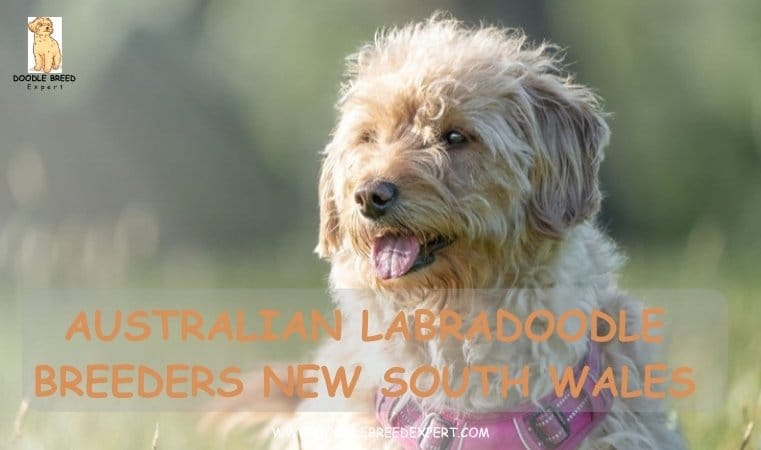
New South Wales has exactly one confirmed Australian Labradoodle breeder in a nationally recognized registry, and that registry isn’t ALAA. It’s WALA, the Worldwide Australian Labradoodle Association, whose member directory lists Inja Labradoodles on a rural property in the Hawkesbury district northwest of Sydney.
New South Wales’s Only WALA-Registered Breeder
Inja Labradoodles operates from Kurrajong, a small Hawkesbury community roughly an hour’s drive northwest of central Sydney on the lower slopes of the Blue Mountains.
The founder trained under Leigh Lewis of Vineyard Labradoodles before starting an independent program, and the kennel still raises its dogs inside the family home on a five-acre lifestyle property rather than in a separate kennel building.
Inja Labradoodles
The program began after the family moved to their Hawkesbury acreage and started fostering breeding dogs through a guardian home arrangement before formally launching Inja Labradoodles as its own kennel.
That guardian-home background shapes how the program still runs today, with breeding dogs living as family pets between litters rather than spending their lives in kennel runs.
WALA’s directory lists Inja under member ID WALA-0520-01335, with Miniature, Medium, and Standard sizes all currently available from the program.
That size spread is broader than most single-breeder listings Doodle Breed Expert has found elsewhere in this project, where a program typically settles on one or two sizes rather than breeding across the full range.
Location: Kurrajong, New South Wales
Website: Inja Labradoodles
Registry: WALA (WALA-0520-01335)
Why ALAA Has No Breeders in Australia
Every earlier article in this series, across dozens of American states and five Canadian provinces, has pointed readers to ALAA, the Australian Labradoodle Association of America.
A direct search of ALAA’s breeder directory turns up nothing at all inside Australia itself, despite the country being where the breed originated.
That gap is why this guide, and the rest of the Australia-focused articles on this site, rely on WALA instead.
WALA was founded by breeders in the United States and Canada.
It has since grown into a genuinely international registry, with member breeders across roughly 30 countries spanning North America, South America, Europe, the United Kingdom and Ireland, the Middle East, Asia, and Australia and New Zealand.
WALA members agree to health-test their breeding dogs, follow the association’s breed standard, and comply with a written code of ethics, with a Diamond Rewards tier recognizing breeders who go beyond the baseline requirements.
Inja Labradoodles isn’t listed as holding that Diamond distinction, which puts it at WALA’s standard membership tier rather than its highest one.
NSW’s New Breeder ID Number Rule
New South Wales tightened its breeding rules on December 1, 2025, when a mandatory breeder identification number requirement took effect under the Companion Animals Act 1998.
Anyone breeding dogs in the state, whether running a large program or dealing with a single accidental litter, must now obtain a breeder identification number, or BIN, through the state’s Office of Local Government.
Breeders with an unplanned litter get a short grace period, 14 days from becoming aware of it or 7 days after the puppies are born, to apply.
Once issued, the BIN has to appear alongside each puppy’s microchip number in any advertisement, and the public can check a breeder’s standing directly through the NSW Pet Registry’s buyer search tool before ever making contact.
That state-level identification requirement sits on top of whatever a breeder’s private registry, ALAA, WALA, or otherwise, already asks for.
A prospective Inja Labradoodles buyer now has two separate numbers worth checking: the WALA membership ID printed on the association’s directory, and the NSW-issued BIN required on any advertisement for the litter itself.
Kurrajong’s Convict-Era History
European settlement reached the Hawkesbury district not long after Governor Phillip’s original exploration of the area around 1790, and by the 1820s colonial surveyors were actively looking for a workable route through the surrounding mountains.
Archibald Bell found that route in 1823, and convict labor gangs spent years cutting the road that opened in 1841 as Bell’s Line of Road, the same road that still runs through Kurrajong today.
Kurrajong sits at roughly 150 meters elevation on the lower slopes of the Blue Mountains, about 8 kilometers from Richmond and around 75 kilometers northwest of central Sydney.
The 2021 census counted 3,113 residents in Kurrajong itself, a modest population for a locality that has spent much of its history oriented around fruit orchards, guest houses, and, more recently, rural tourism rather than dense suburban development.
A dedicated Richmond-to-Kurrajong railway line operated from 1926 until 1952, when repeated landslide damage finally closed it for good.
Orchards dominated the local economy through the late 19th and early 20th centuries, and the guest houses that sprang up to serve Sydney weekenders during the 1920s and 1930s set a pattern of rural retreat tourism that the area still leans into today.
Hawkesbury’s Hotter, Drier Climate
The nearby Richmond weather station, which has recorded observations since 1881, puts the district’s average January maximum at 29.4°C, several degrees warmer than typical summer readings closer to Sydney Harbour, where sea breezes take the edge off the heat.
Average annual rainfall at Richmond runs to about 802 millimeters, spread unevenly across the year rather than concentrated in any single wet season.
Winter is milder but still noticeably cooler than coastal Sydney, with July maximums averaging around 17.3°C and an annual mean minimum near 10.5°C.
That combination, hot inland-style summers paired with foothill-cool winter nights, gives a Kurrajong-raised Labradoodle a genuinely different climate to adjust to than one raised closer to the harbor, with more sun exposure to manage in summer and more temperature swing between day and night year-round.
How the Australian Labradoodle Began
The breed traces to a single, very specific problem solved in Victoria, not New South Wales, in the late 1980s.
A blind woman in Hawaii needed a guide dog, but her husband’s severe allergies ruled out every breed her local guide dog school normally placed.
Wally Conron at the Royal Guide Dogs Association of Victoria crossed a Labrador Retriever with a Standard Poodle and named the resulting puppy Sultan.
Sultan had the right guide-dog temperament and went on to work successfully for ten years.
Conron also recognized that a catchy crossbreed name would help overcome the stigma that typically surrounded mixed-breed dogs at the time, which is how the name “Labradoodle” entered common use.
Shedding remained inconsistent in later litters, so Australian breeders, most notably at the Tegan Park and Rutland Manor kennels, spent the early 1990s folding in Cocker Spaniel, Irish Water Spaniel, and Soft Coated Wheaten Terrier bloodlines to help stabilize a genuinely lower-shedding coat.
That multi-generational Australian foundation is what every WALA and ALAA breeder’s pedigree ultimately traces back to, Inja Labradoodles included, even though the breed’s founding kennels operated in Victoria rather than New South Wales.
Conron has since spoken publicly about regretting some of what the breed’s popularity set off, particularly the flood of poorly bred, opportunistic litters that followed once demand outpaced supply.
That’s part of why a verifiable registry membership matters when choosing a breeder anywhere the demand has grown.
Frequently Asked Questions
It’s the only one Doodle Breed Expert has confirmed in a recognized registry. ALAA’s directory shows no Australia-based members at all, so Inja’s WALA membership is the clearest verifiable listing found in the state.
WALA is the Worldwide Australian Labradoodle Association, an international registry founded by US and Canadian breeders that now covers roughly 30 countries, including Australia. ALAA is the Australian Labradoodle Association of America, and despite its name, its directory currently lists no members based inside Australia.
All three standard Australian Labradoodle sizes: Miniature, Medium, and Standard.
It’s a government-issued number, called a BIN, required for every dog breeder in New South Wales since December 1, 2025. Breeders must include it alongside their puppies’ microchip numbers in any advertisement, and buyers can verify a breeder’s status through the NSW Pet Registry.
Kurrajong is a small Hawkesbury district community on the lower slopes of the Blue Mountains, about 75 kilometers northwest of central Sydney and roughly an hour’s drive from the city.
Not quite. The Hawkesbury district runs hotter in summer and cooler on winter nights than Sydney’s own harbor-moderated suburbs, since it sits inland at the base of the Blue Mountains rather than along the coast.
In Victoria, not New South Wales. Wally Conron created the first Labrador-Poodle cross for the Royal Guide Dogs Association of Victoria in the late 1980s, and later Australian breeders in Victoria refined it into the multi-generational breed recognized today.
Conclusion
New South Wales currently has one verifiable Australian Labradoodle breeder, Inja Labradoodles in the Hawkesbury district, registered with WALA rather than ALAA.
Buyers should confirm current WALA standing directly and check that any advertisement carries a valid NSW breeder identification number, a rule that only began in December 2025.
The Hawkesbury’s hotter, drier climate is worth planning for, since it differs from Sydney Harbour’s milder suburbs. Readers exploring other options can find Doodle Breed Expert’s guides to Queensland, Victoria, Sydney, and the full Australia roundup elsewhere on this site.
Australian Labradoodle Breeders In Other Places
| Alberta | British Columbia | Nova Scotia | Ontario | Ottawa |
| Australia | New South Wales | Queensland | Sydney | Victoria |