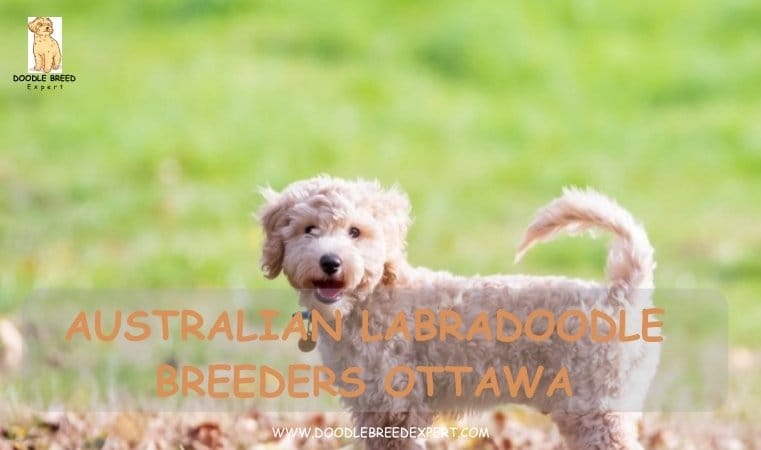
DragonRam Labradoodles is Ontario’s other ALAA-registered breeder, and it’s based specifically inside the city of Ottawa rather than the rural Haldimand County setting covered in Doodle Breed Expert’s broader Ontario guide.
This page focuses on what makes an ALAA breeder operating in Canada’s national capital different, from municipal licensing rules to one of the coldest big-city climates this site covers.
Ottawa’s ALAA-Registered Breeder
Roma and Mathom Quapp run DragonRam Labradoodles from Ottawa, Canada’s capital and the country’s fourth-largest city by population.
The program has built a Golden Paw health-testing record within ALAA’s small Canadian membership, putting it in the same higher tier as Ontario’s other ALAA breeder, Dare to Dream Labradoodles in Caledonia.
Golden Paw status sits above ALAA’s baseline membership requirement, calling for additional hip, elbow, and genetic health clearances on top of the standard testing every member breeder already completes.
DragonRam Labradoodles
Operating a breeding program inside a major city rather than a rural or small-town setting brings its own tradeoffs.
Ottawa’s dense residential neighborhoods mean less open acreage than a rural Ontario or Alberta property might offer.
They also put DragonRam within a short drive of some of the country’s top veterinary specialists and diagnostic imaging centers, both useful when a breeder is running the kind of expanded health screening a Golden Paw distinction requires.
Ottawa’s population passed the one-million mark at the 2021 census, making it Canada’s fourth-largest city and easily the biggest urban center covered anywhere in this Canada series, well ahead of any of the towns hosting Alberta’s or British Columbia’s ALAA breeders.
Location: Ottawa, Ontario
Website: DragonRam Labradoodles
Registry: ALAA (Golden Paw)
Ontario’s Golden Paw Breeders
Both of Ontario’s ALAA breeders currently hold a Golden Paw, ALAA’s second-highest tier, which requires a breeding program to keep expanding hip, elbow, eye, and cardiac testing across multiple generations rather than stopping after a single round.
That puts Ontario ahead of Alberta and British Columbia, where every current ALAA member instead holds the entry-level Silver Paw.
Buyers comparing breeders can ask for a current ALAA certificate number and testing date range directly, since Golden Paw and Silver Paw status are both renewed periodically rather than awarded once and kept for life.
Ottawa’s In-Home Kennel License Rule
The City of Ottawa’s Animal Care and Control By-law sets a standard residential limit of three dogs over 20 weeks old without any special license.
Once a household keeps more than three and fewer than eleven dogs over that age, or houses them primarily in an accessory building rather than the home itself, the by-law classifies the property as an “in-home breeding kennel.”
That classification requires a specific municipal license to operate legally.
That’s a more detailed, breeding-specific category than most of the municipalities Doodle Breed Expert has covered in Canada, where dog licensing typically applies per-animal with no separate kennel or breeder tier at all.
It means an ALAA breeder operating inside Ottawa’s city limits, unlike one working from a rural township elsewhere in Ontario, answers to both the province’s Preventing Unethical Puppy Sales Act and a municipal licensing category built specifically around in-home breeding operations.
Ottawa’s by-law actually splits kennel licenses into several categories beyond in-home breeding, including boarding kennels and recreational kennels, each with its own definition and rules.
That level of detail reflects Ottawa’s position as a large, dense urban municipality trying to regulate everything from backyard breeding to commercial dog daycare under one framework, a very different regulatory challenge than a rural county trying to cover a handful of scattered farms.
Ottawa’s History as a Lumber Town
The city started out as Bytown, a settlement built around the Rideau Canal’s military engineering project in the 1820s, and for decades it wasn’t seriously considered as a candidate for Canada’s capital.
An 1842 proposal to make Bytown the seat of government drew just 6 votes in favor against 57 opposed, with critics dismissing the town as little more than a remote lumber outpost.
Parliament spent years deadlocked between Kingston, Montreal, Toronto, and Quebec City before finally asking Queen Victoria to settle the question.
She chose Ottawa on December 31, 1857, reportedly swayed by its position straddling the border between Upper and Lower Canada and its strategic location at the Rideau Canal’s mouth.
The decision barely survived a reconsideration vote in Parliament and was only finally confirmed in 1859, by a margin of just five votes.
Ottawa’s Cold Winter Climate
Ottawa is routinely ranked among the coldest national capitals in the world, with winter daytime highs typically running between −5°C and −1.5°C and overnight wind chill capable of dropping past −45°C in a hard cold snap.
Summers swing to the opposite extreme, with typical highs near 27°C and the occasional heat wave pushing well past 30°C.
Snowfall is where Ottawa really stands out: the city averages roughly 185 centimeters a year, with February typically the snowiest month.
For a low-shedding wool or fleece coat, that means a genuinely demanding winter routine, regular paw and belly checks for packed snow and ice balls, and booties or paw wax for extended outdoor time.
It also means closer attention to coat drying after a puppy comes in from a slushy Rideau Canal-adjacent walk.
How the Australian Labradoodle Began
Every Australian Labradoodle in existence today, including DragonRam’s own breeding stock, descends from a very specific fix to a very specific problem.
A woman in Hawaii needed a guide dog, but her husband’s severe allergies ruled out the breeds her local guide dog school could normally place.
Wally Conron at the Royal Guide Dogs Association of Victoria in Australia crossed a Labrador Retriever with a Standard Poodle in the late 1980s and named the resulting puppy Sultan.
Sultan had the right guide-dog temperament, but shedding remained a problem in subsequent litters, so breeders folded in Cocker Spaniel, Irish Water Spaniel, and Soft Coated Wheaten Terrier to help stabilize a genuinely lower-shedding coat.
Australian kennels Tegan Park and Rutland Manor spent the early 1990s refining that combination into the multi-generational breed recognized today, and those foundation bloodlines still run through the pedigrees of ALAA breeders across Canada, DragonRam Labradoodles included.
That refinement is also why registries like ALAA classify coat type into fleece, wool, and hair categories, with only the first two typically recommended for allergy-sensitive households, and DragonRam still tests for the trait before matching puppies to buyers.
Frequently Asked Questions
Yes, within city limits. Ontario has one other ALAA member, Dare to Dream Labradoodles, based in Caledonia, well outside the Ottawa area.
A Golden Paw, the same tier Ontario’s other ALAA breeder holds, and a step above the Silver Paw that every current ALAA member in Alberta and British Columbia carries.
Yes. A household keeping more than three dogs over 20 weeks old, or housing dogs primarily in an accessory building, must hold an in-home breeding kennel license under the city’s Animal Care and Control By-law.
Up to three dogs over 20 weeks old. Keeping more than three and fewer than eleven requires an in-home breeding kennel license.
Queen Victoria selected it on December 31, 1857, after Parliament deadlocked between several larger cities, reportedly favoring Ottawa’s position on the border between Upper and Lower Canada and its strategic spot at the mouth of the Rideau Canal.
Ottawa is one of the coldest national capitals in the world, with typical winter highs between −5°C and −1.5°C, wind chill that can pass −45°C, and average annual snowfall around 185 centimeters.
Seven, spread across four provinces: two each in Alberta, British Columbia, and Ontario, one in Quebec, and none currently in Nova Scotia.
Conclusion
DragonRam Labradoodles brings ALAA’s Golden Paw standard into Canada’s capital itself, operating under both Ontario’s new puppy-mill law and Ottawa’s own in-home breeding kennel license, a more detailed municipal framework than most of the cities and provinces covered elsewhere on this site.
That layered oversight, on top of ALAA’s own testing requirements, gives Ottawa buyers more to check than a simple registry lookup.
Ottawa’s brutal winters are the other big factor worth planning around, since a puppy heading into one of the world’s coldest national capitals needs a genuinely cold-weather-ready coat care routine from its first winter on.
Buyers should confirm current ALAA standing directly with the registry before committing to a puppy.
Australian Labradoodle Breeders In Other Places
| Alberta | British Columbia | Nova Scotia | Ontario | Ottawa |
| Australia | New South Wales | Queensland | Sydney | Victoria |