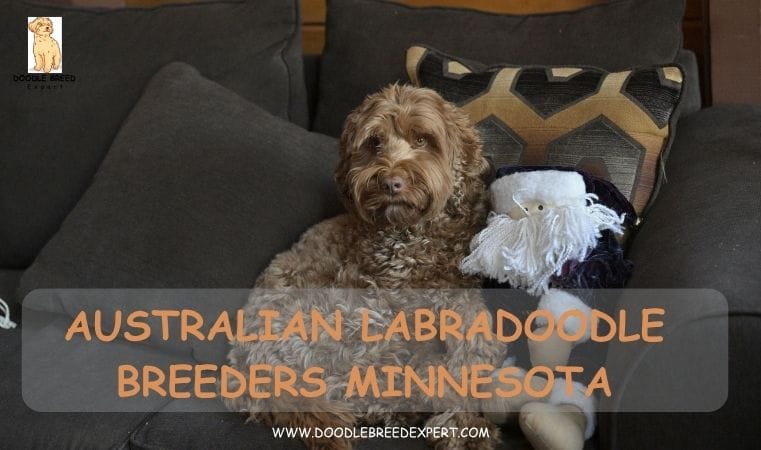
Minnesota may have fewer registered Australian Labradoodle breeders than its neighbors, but the ones that do exist are recognized by official registries, and several Minnesota-based general doodle breeders also include Australian Labradoodles among their litters. Below is what each breeder actually offers, what Minnesota law does and doesn’t hold them accountable for, and why the Twin Cities metro sits squarely inside deer tick country.
What a Minnesota Australian Labradoodle Costs
For the most part, small Minnesota doodle breeders in this niche don’t list pricing on their websites, a common practice for small programs that prefer to discuss cost directly with interested families. Among the few prices found by looking at nearby Midwest doodle breeders, costs ranged from about $2,500 to $3,500, with deposits typically running $250 to $500 and credited toward the final price.
Puppies priced significantly under $2,000 deserve scrutiny no matter where you live, since legitimate health testing and registration fees add real cost to breeding a litter.
Adopting an Australian Labradoodle in Minnesota
Buying from a breeder isn’t the only option available to Minnesota residents. Multiple rescue organizations and shelters across the state place doodle-type mixed breeds, and a few nonprofits specialize in tracking down Labradoodle-type puppies for interested families.
- Minnesota animal shelters and humane societies that periodically take in Labradoodle and poodle-mix surrenders
- Regional doodle rescue networks that list Minnesota dogs through Adoptapet and Petfinder
- Good Dog’s adoption section, which sometimes lists owner-surrendered Australian Labradoodles from the Upper Midwest
Minnesota’s Puppy-Sale Law Only Applies to Certain Sellers
Minnesota Statutes Sections 325F.79 through 325F.792 govern the sale of dogs and cats and protect buyers from a “pet dealer,” defined as anyone required to collect sales tax on animal sales. If a breeder meets that definition, the law requires a veterinary exam within two business days of receipt, gives buyers two business days to return an unhealthy puppy for a full refund, extends that window to ten days for an illness that surfaces later, and allows up to a full year for a refund tied to a hereditary or congenital defect.
The question of whether a specific small, home-based breeder actually qualifies as a “pet dealer” isn’t always clear-cut, since the definition turns on a sales-tax standard rather than anything breeder-specific. Because of that ambiguity, a written health guarantee from the breeder remains important even when a buyer’s statutory rights aren’t obvious.
Minnesota’s separate law on commercial dog and cat breeding only requires a state license once a facility houses 10 or more intact adult animals and produces more than 5 litters a year. Most Australian Labradoodle breeders in the state fall well short of that threshold, which is why holding a commercial breeder license is rare among them.
Minnesota’s Registry-Affiliated Australian Labradoodle Breeders
Rum River Australian Labradoodles
Rum River Australian Labradoodles, run by William and Mary Rost near Andover, north of the Twin Cities, is registered with WALA and produces multigenerational, ALCA-registered Australian Labradoodles in mini and medium sizes.
Breeding stock is tested for hips, elbows, cardiac issues, eyes, and patellas, along with a full genetic inheritable-disease panel, and the program offers a guardian-home arrangement to families within about an hour of Minneapolis-St. Paul.
Location: Andover, Minnesota
Contact: Available through the website below
Website: Rum River Australian Labradoodles
Registry: WALA, ALCA
Willowbea Australian Labradoodles
Willowbea Australian Labradoodles, run by Jennifer Wareham out of Afton in the St. Croix River Valley east of the Twin Cities, is a family-based breeder registered with WALA, and all breeding stock is fully tested before being bred using WALA’s testing protocols.
Puppies raised at Willowbea go through the Puppy Culture program, including early neurological stimulation and scent introduction, and Jennifer describes her approach as breeding with intention, focusing on health, temperament, and structure over quantity.
Location: Afton, Minnesota
Contact: willowbeadoodles@gmail.com
Website: Willowbea Australian Labradoodles
Registry: WALA
Other Minnesota Doodle Breeders Worth Knowing About
The programs listed below breed Labradoodles in Minnesota, but Hidden Valley Doodles, Grace Kennel, and Doodle Nation don’t offer evidence of ALAA, WALA, or ALCA registration. That means they may be working with earlier-generation Labradoodles alongside or instead of multigenerational Australian Labradoodles, so it’s worth a direct conversation if the two registered breeders above don’t have availability that fits your timeline.
Hidden Valley Doodles
Hidden Valley Doodles is located in Millville, northeast of Rochester, and breeds several doodle varieties, including Standard, Medium, and Miniature Australian Labradoodles, Aussiedoodles, and Bernedoodles, offering a mix of F1, F1B, and multigenerational litters. Puppy sizes typically range from 20 to 35 pounds, and every puppy comes with a 1-year health guarantee.
Location: Millville, Minnesota
Phone Number: (507) 696-3647
Website: Hidden Valley Doodles
Grace Kennel (GK Poodles N Doodles)
Grace Kennel, based in Saint Cloud, breeds standard, medium, and mini Labradoodles and is part of the Good Dog Responsible Breeding Program. Puppies are raised using the Puppy Culture protocol, including early neurological stimulation, and each one comes with a 2-year genetic guarantee.
Location: Saint Cloud, Minnesota
Phone Number: 612-242-3534
Website: GK Poodles N Doodles
Doodle Nation
Doodle Nation, located in Bruno in east-central Minnesota, breeds standard and mini Labradoodles in F1 and F1B litters and is inspected by the Minnesota Board of Animal Health, which typically applies once a program crosses the state’s commercial-breeder thresholds.
Location: Bruno, Minnesota
Phone Number: 612-227-2073
Website: Doodle Nation
Minnesota Is Deer Tick Country for Most of the State
Blacklegged (deer) ticks have been identified by the Minnesota Department of Health as “established” in 73 of Minnesota’s 87 counties, present throughout nearly all areas of the state, including the Hennepin, Ramsey, and Dakota counties that make up the Twin Cities metro. Only a small handful of southwestern counties have had no ticks confirmed to date.
As a result of this widespread tick presence, the state reported 2,685 probable Lyme disease cases in 2022, with most likely exposures traced to the east-central, north-central, and southeast regions of Minnesota. Symptom onset peaks between May and September, matching the tick season.
Given how widespread established tick populations are across the state, year-round, vet-prescribed tick prevention is worth treating as standard for a Minnesota Australian Labradoodle rather than something to start only in summer.
Minnesota’s cold winters and humid summers also mean an Australian Labradoodle’s fleece or wool coat needs regular brushing, both to manage shedding and to make ticks easier to spot during peak months.
The Allergy Problem That Started the Whole Breed
There was no attempt by Wally Conron or anyone else involved in developing the Australian Labradoodle to chase some new trend. A woman in Hawaii wanted a guide dog for herself, but her husband suffered an allergic reaction to every standard guide-dog breed available at the time.
The first cross-breed litter that would eventually become the Australian Labradoodle was bred by Wally Conron while he worked for the Royal Guide Dogs Association of Australia in the 1980s. Conron’s intention was to combine a guide dog’s temperament with a coat that wouldn’t trigger allergies. It turned out the Labrador-Poodle mix succeeded on temperament, but the puppies still shed about as much as a purebred Labrador, so over the following years breeders added Cocker Spaniel, Irish Water Spaniel, and Soft Coated Wheaten Terrier into the original breeding lines.
By the early 1990s, foundational Australian programs like Tegan Park and Rutland Manor had stabilized the coat and temperament traits that define the breed today. Those same bloodlines still trace through the pedigrees of WALA- and ALCA-certified breeders in Minnesota and across the country, decades and a continent removed from where the breed began.
Frequently Asked Questions
Only to a limited extent. In Minnesota, a “pet dealer” is defined as someone selling animals who is required to charge sales tax. If a breeder is classified as a pet dealer, you generally have two business days to return a sick animal for a refund, extending to ten days for an illness that surfaces later or up to a full year for a hereditary or congenital defect. It isn’t always easy to tell whether a small breeder actually qualifies as a pet dealer, so a written health guarantee remains your most reliable protection.
Only above a fairly high threshold. Once a facility in Minnesota keeps 10 or more intact adult dogs and produces more than 5 litters a year, it needs a commercial dog and cat breeder license. Nearly every active Australian Labradoodle breeder in the state operates well below that combined threshold, which is why none of them currently need one.
Blacklegged ticks have been found throughout most of Minnesota, confirmed present in 73 of the state’s 87 counties, including the entire Twin Cities metro, and the state reported over 2,600 probable Lyme disease cases in 2022. Treating year-round tick prevention as standard practice, rather than seasonal, is the safer approach anywhere in Minnesota.
No. There are only a couple of Minnesota programs registered with an Australian Labradoodle registry. Several other Minnesota breeding programs label their puppies as Australian Labradoodles without an actual registry affiliation, so it’s worth confirming a program’s specific registry status before assuming it meets the multigenerational standard.
It varies. With only a few registry-affiliated Australian Labradoodle specialists in the state, waiting times can run longer than in states with more established programs. Contacting a potential breeder directly to ask about upcoming litters well before you’re ready to bring a puppy home is worth doing.
Conclusion
Minnesota has fewer registry-affiliated Australian Labradoodle breeders than many other states, with Rum River and Willowbea the two clearest examples, alongside several general doodle breeders who also offer Labradoodles without the same registry credentials. Because it isn’t always clear whether a small Minnesota breeder counts as a pet dealer under the state’s puppy-sale law, a written health guarantee matters just as much here as verified registry status.
Confirm any breeder’s WALA or ALCA status directly with the registry, get a written health guarantee before any deposit changes hands, and treat year-round tick prevention as essential given how much of the state has established deer tick populations.
Australian Labradoodle Breeders In Other Places
| Alabama | Arizona | California | Colorado |
| Connecticut | Florida | Georgia | Illinois |
| Indiana | Iowa | Maine | Maryland |
| Massachusetts | Michigan | Minnesota | Missouri |
| New England | New Jersey | New York | North Carolina |
| Northern California | Ohio | Oregon | Pennsylvania |
| South Carolina | Southern California | Tennessee | Texas |
| Utah | Virginia | Washington | Wisconsin |
| East Coast | San Diego |
| Alberta | British Columbia | Nova Scotia | Ontario | Ottawa |
| Australia | New South Wales | Queensland | Sydney | Victoria |