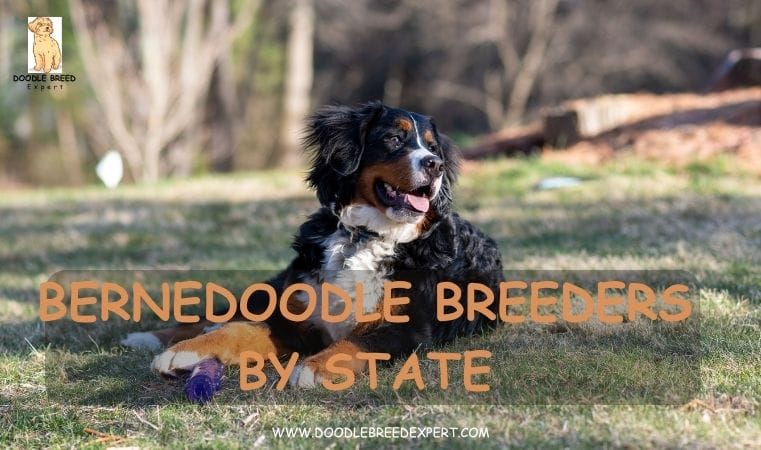
Demand for Bernedoodles is intense right now, and it shows in the search results, so type in “Bernedoodle breeders near me” and you’ll find backyard breeders and outright puppy mills crowding out the handful of programs actually worth your time. This directory rounds up trustworthy Bernedoodle breeders by state, all in one place.
Reviewed by Dr. Muhammad Usman, DVM.
How to Use This Bernedoodle Breeders by State Directory
Each link below goes to a dedicated guide to Bernedoodle breeders by state, covering local breeders, typical pricing, and what to look for before you commit to a deposit. If you want the full picture on Bernedoodle sizes, coat colors, and generations before you start contacting breeders, start with our Mini Bernedoodle guide and Bernedoodle lifespan guide.
Bernedoodle Breeders by State
Here’s a quick side-by-side look at what to expect in each state before you dive into the full guides:
| State | Typical Price Range | Worth Knowing |
|---|---|---|
| California | $2,500–$4,000+ | Highest demand in this directory; several breeders offer expanded health panels beyond standard OFA testing |
| Florida | $2,500–$4,000+ | Long waitlists are common, and licensing rules vary by city and county, so ask directly |
| Illinois | $2,500–$4,000 | F1B and multigenerational litters tend to price at the higher end |
| Indiana | $2,000–$3,500 | Generally the most affordable of the five; many breeders operate below the state’s commercial registration threshold |
| Georgia | Varies by breeder | Pricing isn’t usually posted publicly, so ask directly and compare against health testing offered |
We’re actively expanding this list to cover more states, including Texas and North Carolina, so check back soon, or see our Aussiedoodle breeders directory if you’re also considering that breed.
Don’t See Your State Listed? Here’s How to Vet a Breeder Anywhere
This directory of Bernedoodle breeders by state currently covers five states, and we’re working to add more. If you’re searching outside California, Florida, Georgia, Illinois, or Indiana, you can still apply the same standards on your own. Start by asking for OFA hip, elbow, and genetic panel results, then check them directly against the free public database at ofa.org rather than taking a breeder’s word for it, since health certificates are only useful when they’re verifiable. Local or regional Bernese Mountain Dog and Poodle breed clubs often keep referral lists of members who cross-breed responsibly, and they’re a useful second opinion beyond a breeder’s own website. Bernedoodle-specific Facebook groups and forums are also worth checking to see whether other buyers have had a good experience with a specific breeder before you commit to a deposit. Wherever you’re located, the questions and red flags on this page apply the same way.
Regional Pricing and Availability
Bernedoodle pricing tends to run higher than Aussiedoodle or Labradoodle pricing across the board, since Bernese Mountain Dog bloodlines are less common and costlier to health-test. California and Florida breeders typically price at the top of the range given local demand, while Midwest programs in Illinois, Indiana, and Georgia are often more competitive without cutting corners on testing. Standard-size litters also tend to sell out faster than mini or tiny litters, simply because demand for the smaller sizes outpaces supply.
Because there are fewer dedicated Bernedoodle breeders overall compared with Aussiedoodles or Goldendoodles, waitlists tend to run longer too, commonly a few months up to a year for a health-tested litter, with popular colors like tri-color or merle often pushing that further out. If you’re not committed to a specific state, widening your search to a neighboring one can shorten the wait and sometimes lower the price, as long as you hold the breeder to the same health-testing standard regardless of location.
Watch for Scams When Reaching Out to Breeders
Bernedoodles carry some of the highest price tags in the doodle world, which makes them a frequent target for online puppy scams. Be cautious of any seller who won’t do a live video call with the puppy and both parents, whose photos turn up on other breeders’ listings or unrelated sites in a reverse image search, or who pressures you to wire money, send a gift card, or pay a deposit before you’ve spoken with them directly. A legitimate breeder will welcome questions about health testing and let you see where the puppies are actually raised, in person or over video. If a deal feels rushed, or a price looks too good given everything above, treat that as a reason to slow down rather than act fast.
Five Questions to Ask Any Bernedoodle Breeder
- Can I see OFA hip/elbow certification and genetic panel results for both parents? Ask specifically about testing for Von Willebrand’s disease, degenerative myelopathy, and progressive retinal atrophy, all conditions that can pass down from the Bernese Mountain Dog and Poodle lines.
- Has this line been tracked for cancer history? Bernese Mountain Dogs carry a higher-than-average cancer risk, and a responsible breeder should be able to speak to it honestly rather than deflect.
- What size and generation is this litter (F1, F1B, multigen)? This affects both adult size and shedding, so make sure it matches what you’re expecting.
- What’s included in the health guarantee, and for how long? Get it in writing.
- Can I see the puppy’s living environment? In-home raising with early socialization tends to produce better-adjusted adult dogs than kennel-only environments.
Vet’s note: Reviewed by Dr. Muhammad Usman, DVM. Because Bernedoodles inherit a real cancer risk from the Bernese Mountain Dog side, buyers should ask every breeder directly whether cancer history is tracked in their line. There’s no single genetic test for it the way there is for Von Willebrand’s disease or PRA, so a breeder’s honesty on this question matters more than any piece of paper.
Frequently Asked Questions
How much does a Bernedoodle puppy typically cost?
Health-tested Bernedoodle puppies commonly run $2,500 to $5,000, with mini and tiny sizes and rarer coat patterns like tri-color or merle often landing at the higher end. Standard-size litters from established programs tend to fall in the middle of that range.
What’s the difference between a standard, mini, and tiny Bernedoodle?
A standard Bernedoodle typically weighs 50–90+ lbs, a mini runs 25–49 lbs, and a tiny or micro Bernedoodle stays in the 10–24 lb range. Size comes down mostly to which size of Poodle was used in the cross, and smaller dogs generally trend toward longer lifespans.
Are Bernedoodles hypoallergenic?
No dog is fully hypoallergenic, but Bernedoodles with more Poodle influence (F1B and later generations) shed noticeably less than a purebred Bernese Mountain Dog, which is why they’re a common pick for mildly allergy-sensitive households.
Is it worth waiting for a specific state’s breeder versus expanding my search?
If a well-established, health-testing breeder in a neighboring state offers a shorter waitlist or better pricing, it’s usually worth the drive or flight. Prioritize health testing and transparency over proximity alone.
Are there Bernedoodle rescues instead of buying from a breeder?
Yes, though less commonly than for more established breeds, since Bernedoodles are still relatively new to rescue circulation. It’s worth checking regional Bernese Mountain Dog and Poodle rescue groups, which occasionally place doodle mixes looking for a second home.
How long is the typical wait for a Bernedoodle puppy?
Based on the breeder profiles across this directory, expect anywhere from a few months up to a year, with popular colors and mini or toy sizes often at the longer end. Because Bernedoodle breeders are less numerous than Aussiedoodle or Labradoodle breeders, waitlists can run longer than for other doodle breeds, so it’s worth reaching out several months before you’d like to bring a puppy home.