
If you’ve been shopping for a Labradoodle puppy, you’ve probably seen generation labels like F1, F1B and F1BB, and wondered whether those extra letters matter. For many allergy-sensitive families, they do. An F1BB Labradoodle is bred back to the Poodle twice, which pushes the coat further toward the curly, low-shedding Poodle type.
This guide will explain exactly what F1BB means, what type of coat you should expect, the expected temperament for your dog, how large an F1BB can be and how it compares to other generations.
Quick answer: An F1BB Labradoodle is a cross between an F1B Labradoodle and a Poodle. On paper it’s about 87.5% Poodle and 12.5% Labrador, so most F1BB puppies have curly or tight wavy coats with very low shedding.
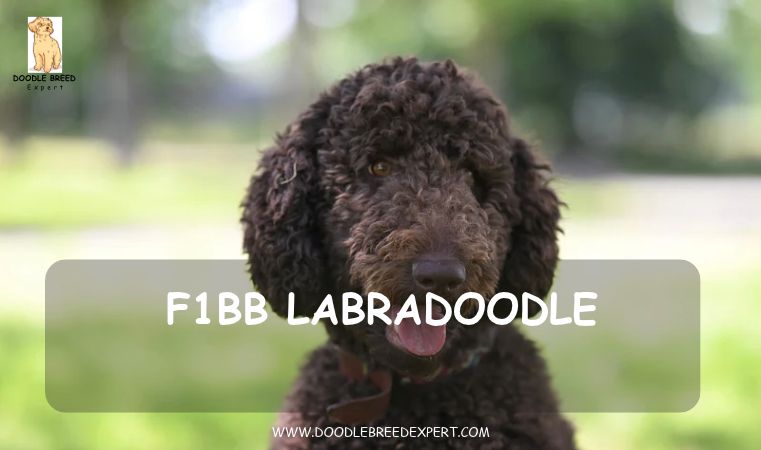
What Does F1BB Mean?
Doodle generation codes give an indication of how many times a line has been crossed and with what breed of dog.
- F1: Labrador x Poodle (about 50% each)
- F1B: F1 Labradoodle x Poodle (about 75% Poodle)
- F1BB: F1B Labradoodle x Poodle (about 87.5% Poodle)
- F2, F2B, multigen: later generations bred doodle to doodle, sometimes with Poodle backcrosses
F is for filial which represents a cross; the number 1 is referring to the first cross, so it indicates how many crosses were made, and B represents a back-cross to the Poodle. Therefore an F1BB would be two back-crosses.
Percentages are averages on paper. Each puppy inherits a random mix of genes, so even two F1BB littermates could look slightly different, depending on which genes they inherited.
F1BB Labradoodle Coat and Shedding
The main reason people choose an F1BB Labradoodle is the coat. With so much Poodle background, most F1BB puppies inherit:
- Furnishings (beard and eyebrows), because Poodles are almost always furnished
- Curly or tight wavy coats, from the Poodle curl gene
- Very low shedding, often lower than F1 or F1B dogs
Low-shedding characteristics make F1BB dogs an attractive option for individuals who have some level of allergy to dogs. Please understand, however, that allergens are found in the salivary glands, skin and dander (a protein-based material), as well as in their coat. No “doodle” can be considered completely hypoallergenic. The best way to determine your allergic reaction to a puppy is by spending time with an adult dog from the same breeding program.
Grooming needs
Curlier coats shed less but mat more than wavy or straight coats. An F1BB labradoodle typically needs:
- Brushing every day or every other day, down to the skin
- A professional groom every 6 to 8 weeks
- Regular ear cleaning and plucking or trimming as your vet advises
Temperament
With more Poodle in the mix, F1BB Labradoodles often lean toward the Poodle personality: very smart, sensitive, alert and people-focused. Many still have the Lab’s friendliness and love of food, which makes training easier. Expect a dog that learns fast and gets bored easily, so mental exercise matters as much as walks.
Some F1BB dogs are a bit more reserved with strangers than an F1, reflecting the Poodle side. Early socialization helps a lot.
F1BB Labradoodle Size
The size of an F1BB is determined primarily by which type of poodle was used in each generation. As F1BBs were bred back two times to a Poodle; breeders can reduce their size quickly by breeding them to either Miniature or Toy poodles.
| Size | Typical adult weight | Typical height |
|---|---|---|
| Mini | 15 to 30 pounds | 14 to 16 inches |
| Medium | 30 to 45 pounds | 17 to 20 inches |
| Standard | 45 to 65+ pounds | 21 to 24 inches |
Ask your breeder to get you the weight of both of the parent dogs and also the puppy’s weight from previous litters so this will give you the best possible estimate.
Health of F1BB Labradoodles
F1BB Labradoodles share the health risks of both parent breeds, with Poodle conditions becoming a bit more relevant as the Poodle percentage rises:
- Hip and elbow dysplasia
- Progressive retinal atrophy and other eye diseases
- Addison’s disease and sebaceous adenitis (Poodle side)
- Patellar luxation in mini sizes
- Ear infections, especially in hairy ears
- Bloat in standard sizes
Some folks think hybrid vigor is lost after every back cross. Health has much more to do with whether the parents have been tested as opposed to what generation they are. Request Hip, Elbow and Eye exam data. Also ask about DNA testing for conditions such as PRA (Progressive Retinal Atrophy) and vWD (von Willebrand Disease).
F1BB vs F1B vs Multigen Labradoodle
| Generation | Poodle % | Shedding | Coat consistency |
|---|---|---|---|
| F1 | ~50% | Low to moderate | Least predictable |
| F1B | ~75% | Low | More predictable |
| F1BB | ~87.5% | Very low | Predictable, often curly |
| Multigen | Varies | Low (if well bred) | Depends on breeder’s program |
F1s and F1Bs are ideal if you love the shaggy, wavy “lab-like” doodle appearance but also don’t mind some amount of dog hair. On the other hand, if shedding is your number one concern then an F1BB or a well bred multi-gen doodle would likely be your best bet.
How Much Does an F1BB Labradoodle Cost?
Prices vary by breeder, size and location, but F1BB puppies often cost about the same as F1B puppies, commonly in the $2,000 to $4,000 range in the US. Mini sizes and rare colors may cost more. Puppies from health-tested parents are worth paying for.
Is an F1BB Labradoodle Right for You?
If your desire is for an extremely low-shedding, curly, teddy bear-coated dog which will also be smart and easily trainable; then an F1BB labradoodle may be right for you. However, it would probably not be suitable as a pet for someone who does not have time for daily brushing and professional grooming every 6 to 8 weeks.
For another popular Labradoodle type, read our guide to the Australian Labradoodle, which uses multigeneration breeding with additional breeds.
Frequently Asked Questions
What is an F1BB Labradoodle?
The combination is of a F1B Labradoodle and a Poodle (so about 87.5% Poodle & approximately 12.5% Labrador).
Do F1BB Labradoodles shed?
Most shed very little. The majority of their coats have a tight curl or wave as a result of them having so much Poodle in their ancestry.
Is an F1BB Labradoodle hypoallergenic?
No dog is totally hypoallergenic; however, F1BB Labradoodles are probably one of the best options available to individuals who suffer from mild allergies.
Is F1BB better than F1B?
Not better, just different. F1BB usually relates to less shedding and greater grooming needs. The F1B retains a bit more of the Labrador Retriever’s overall appearance.
How big do F1BB Labradoodles get?
It depends on the Poodle used. Minis are about 15 to 30 pounds, mediums 30 to 45, and standards 45 pounds or more.
Final Thoughts
An F1BB Labradoodle is a great choice for families who want the lowest-shedding coat possible with a dash of Labrador friendliness. Just remember that a curly coat means more grooming, and that health testing matters more than any generation label.